
The Story
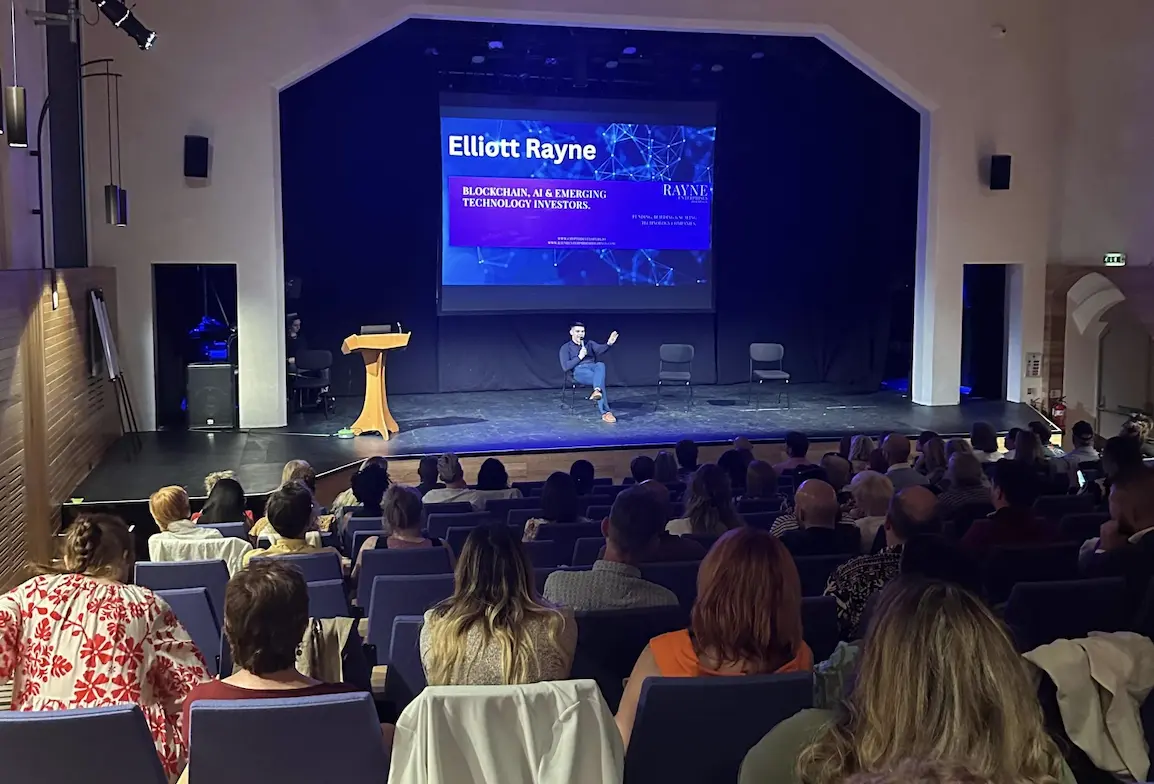
“I think the most interesting AI problems are behind data we refuse to monitor.”
15 years making complex technology feel simple.
If you had asked Elliott Rayne at 15 what he thought his career would look like, he probably couldn’t have given you an answer.
He’d already left school.
He knew he loved technology. He knew he wanted to build things. Beyond that, there wasn’t much of a plan.
Looking back, that uncertainty was probably one of the best things that could have happened to him.
Elliott wasn’t following a career path because he didn’t really have one to follow.
Instead, he followed whatever he found interesting.
And for the next few years, that took him down some fairly unusual rabbit holes.
It started with technology
Elliott had started teaching himself about technology a few years earlier, around the age of 12.
By 15, it had become considerably more serious.
After leaving school, he went to college to study technology. The syllabus was designed to take two years. He completed it in around six weeks.
That sounds ridiculous written down now.
At the time, Elliott didn’t think much of it. He had simply found something he was obsessed with and wanted to move faster.
Technology gave him something traditional education never really had.
Immediate feedback.
You could have an idea in the morning, build something in the afternoon, break it by dinner and understand considerably more by the time you went to bed.
He loved that.
And once Elliott realised how much you could create with relatively little more than a computer, an internet connection and enough stubbornness, he was hooked.
His first, and only, job
Before Elliott properly disappeared into building companies, he had one conventional job.
It also turned out to be his last.
He worked at British Telecom as an engineer.
For someone who had spent most of his teenage years thinking about technology from the perspective of what could be built, BT gave Elliott a completely different education.
For the first time, he could see how a huge organisation actually operated underneath the surface.
Technology was only one part of it.
There were management structures, departments, processes, reporting lines, responsibilities and layers of decision-making.
Elliott learned how people worked together across a large organisation, how managers communicated, how decisions travelled through different levels of a business and why changing something inside an enterprise was fundamentally different from changing something inside a small company.
It put structure around something he had never really understood before: how a conglomerate actually works.
Elliott didn’t stay in traditional employment for long. In fact, BT remains the only job he has ever had.
But he took far more from that experience than he realised at the time.
Small companies can often make a decision and move.
Enterprises don’t work like that.
There are dependencies, permissions, stakeholders, existing systems, governance structures and consequences that aren’t always obvious from the outside.
Those lessons stayed with him.
Today, when Elliott walks into a large organisation and tries to understand its technology, people and processes, he doesn’t approach it as though it’s simply a bigger version of a small business.
It isn’t.
That early understanding of how enterprises think, manage and operate has stayed with him throughout his career.
Years later, it would become surprisingly relevant again.
Then he found blockchain
Blockchain became Elliott’s first real rendezvous with an emerging technology before the rest of the world had quite decided what it was going to become.
He went deep.
Not just into cryptocurrency, but into the technology underneath it: blockchain infrastructure, smart contracts and the idea that software could coordinate transactions and agreements without traditional intermediaries.
It was messy.
The technology was early. The industry moved ridiculously quickly. Things that looked revolutionary one month could be irrelevant six months later.
But that environment suited him.
Elliott built businesses around the technology, worked with developers, built platforms and eventually found himself running something far bigger than the projects he had started with.
One platform grew to more than 5,000 paying members.
And somewhere along the way, something changed.
He wasn’t just building technology anymore.
He was building companies.
Learning to run something bigger than himself
There’s a strange moment when something you’ve built stops feeling like a project.
People start using it.
Then more people start using it.
Suddenly there are customers, employees, deadlines, infrastructure, problems and people depending on the decisions you make.
The thing you were building has become a business.
That transition taught Elliott more than any course ever could.
Because technology is usually the clean part.
Companies aren’t.
Companies are people, incentives, processes, customers, regulations, old software, new software, brilliant ideas, terrible ideas and hundreds of small decisions happening at the same time.
As the businesses grew, Elliott’s role naturally changed too.
He went from spending most of his time building things himself to managing teams, working with engineers, thinking about architecture and trying to make complicated technology understandable to the people using it.
Somewhere in that transition, he became a manager.
Then a leader.
And eventually, the person responsible for making decisions when there wasn’t an obviously correct answer.
He still hasn’t completely cured himself of opening a blank repo when he should probably be doing CEO things.
He’s not sure he ever will.
Some unexpected doors opened
As the businesses grew, so did the opportunities around them.
In 2019, Elliott received the TSB UK NextGen Entrepreneur Award.
He later had opportunities to present at both the House of Lords and the House of Commons.
There were press features, events and rooms he never expected to find himself in when he first started playing around with technology as a kid.
He remains grateful for all of it.
But Elliott has never really viewed the awards or recognition as the story itself.
They were consequences of the work.
The more valuable part of those years was what the work taught him.
He learned what happens when technology leaves your laptop and becomes something thousands of people depend on.
He learned that managing engineers is very different from being one.
He learned how difficult it is to make complicated technology feel simple.
And he learned that being early to an emerging technology can be incredibly valuable, provided you can separate what is genuinely useful from what is simply exciting.
Elliott also learned that success in one industry doesn’t automatically mean you should go chasing another one.
That lesson was slightly more expensive.
The time he tried something completely different
Not everything Elliott built worked.
One of the more useful failures was EJ Events UK.
By that point, he’d had success in technology and, if he’s being completely truthful, some of that success probably made him believe he could apply the same formula almost anywhere.
So he tried something different.
Different product. Different market. Different business entirely.
Events.
Part of it was curiosity. Part of it was ambition. And part of it was probably greed.
Elliott had seen what was possible when a business worked and thought he could take what he’d learned, enter another market and make it work there too.
It didn’t.
EJ Events UK failed.
At the time, that obviously wasn’t particularly enjoyable.
Looking back, Elliott is glad it happened.
It taught him something surprisingly simple.
Just because you can pursue an opportunity doesn’t mean you should.
He had spent years developing an advantage in technology. He understood the products. He understood technical teams. He understood how technology businesses operated.
Most importantly, he genuinely enjoyed the work.
Then he walked away from that advantage to chase something completely different.
There’s value in diversification, but there’s also enormous value in knowing your lane.
EJ Events reminded Elliott what his was.
Technology wasn’t simply an industry he happened to have found success in.
It was the thing he actually wanted to spend his time understanding and building.
He has carried that lesson with him ever since.
There will always be another interesting market, another opportunity and another shiny object promising a faster route somewhere.
Elliott is considerably less interested in chasing them now.
Sometimes the best business decision is knowing what not to build.
That lesson would become particularly important as his attention started moving towards something new.
In 2020, AI caught his attention
Artificial intelligence obviously wasn’t new in 2020.
But Elliott’s relationship with it was.
He started spending more time looking at what was happening with machine learning and increasingly capable language models.
Something felt different.
He’d already lived through one major technology cycle with blockchain, so he had developed a healthy scepticism towards hype.
Elliott knew how quickly an emerging technology could become surrounded by enormous claims, speculative businesses and people desperately trying to attach themselves to whatever was fashionable that month.
He didn’t want to build an “AI company” because AI sounded exciting.
He wanted to understand it.
What could these systems actually do?
Where did they fail?
What happened when you connected them to other software?
What would happen as the models became more capable?
And eventually, what would happen when you took AI out of a controlled environment and installed it inside an actual company?
Elliott kept following those questions.
Then the models got better.
And better.
Eventually, it became impossible to ignore what was happening.
For most of his career, software had been deterministic. People told computers what to do and, broadly speaking, they did it.
AI introduced something fundamentally different.
Software could begin interpreting information, reasoning through problems, communicating naturally and increasingly deciding what should happen next.
That opened an entirely new design space.
That eventually became RayneAI
Elliott’s career gradually moved with it.
Curiosity became experimentation.
Experimentation became projects.
Projects became increasingly sophisticated systems.
Eventually, AI became the primary technology around which Elliott and his team wanted to build.
Today, that work happens through RayneAI.
His role has changed again too.
Elliott spends far less time being the person personally building every component and far more time leading teams, working alongside engineers, thinking about architecture and deciding which problems are actually worth solving.
Although give him a hackathon and an idea he probably shouldn’t be spending his weekend on, and there’s still a good chance he’ll disappear for a while.
Some habits survive becoming a CEO.
The problems Elliott and his team work on now are considerably larger.
One area of particular interest is enterprise AI and what they call AI sub-agent divisions.
Instead of asking one AI system to do everything, they think about how specialised agents can have their own responsibilities, permissions and access to information, while communicating and working together across an organisation.
Strangely, that brings Elliott back to some of the things he first learned at BT.
Departments have responsibilities.
People have permissions.
Information moves between different parts of an organisation.
There are management structures, escalation paths and boundaries around who can make which decisions.
Enterprise AI has to understand that world too.
It isn’t enough to make several AI agents communicate.
You have to think about what information can move between them, what each agent is allowed to do, where authority sits, when humans need to intervene, how actions are audited and how the entire architecture operates within the security, compliance, liability and governance requirements of the organisation.
Technology has changed enormously since Elliott’s first job.
Some of the underlying organisational problems haven’t.
He still feels like he’s at the beginning
There have been businesses, awards, failures, strange turns, mistakes, good decisions and plenty of bad ones between Elliott leaving school and where he is today.
But he doesn’t really see his career as a collection of milestones.
There has been one fairly consistent thread running through all of it.
Elliott tends to find technologies that interest him, become slightly obsessed with understanding them, and then spend the next few years figuring out where they actually belong.
Blockchain was one chapter of that story.
AI has become a much bigger one.
And despite having spent most of his life around technology, Elliott doesn’t think he has ever been more curious about what comes next.
There’s still a lot to build.
You can see what Elliott and his team are building, or explore a project, at RayneAI.com.
You can follow Elliott on LinkedIn, at linkedin.com/in/elliottrayne/
What I’m thinking about right now.
-
How AI Agents Should Actually Communicate Inside an Enterprise
Read Article: How AI Agents Should Actually Communicate Inside an EnterpriseThe first time you build two AI agents that can talk to each other, it feels slightly magical. One agent completes part…
-
Why Most Enterprise AI Projects Never Make It Past the Prototype
Read Article: Why Most Enterprise AI Projects Never Make It Past the PrototypeThere’s a moment in almost every AI project where everything feels easier than expected. The prototype works. Someone connects a model to…
-
AI Sub-Agent Divisions: How I Think the Enterprise Will Be Rebuilt Around AI
Read Article: AI Sub-Agent Divisions: How I Think the Enterprise Will Be Rebuilt Around AIFor most of the history of business software, we’ve built technology around people. Finance has its systems. Sales has its CRM. Operations…
The best place to understand how I think is the writing.
Browse the blog, or connect with me if there is something worth discussing directly.